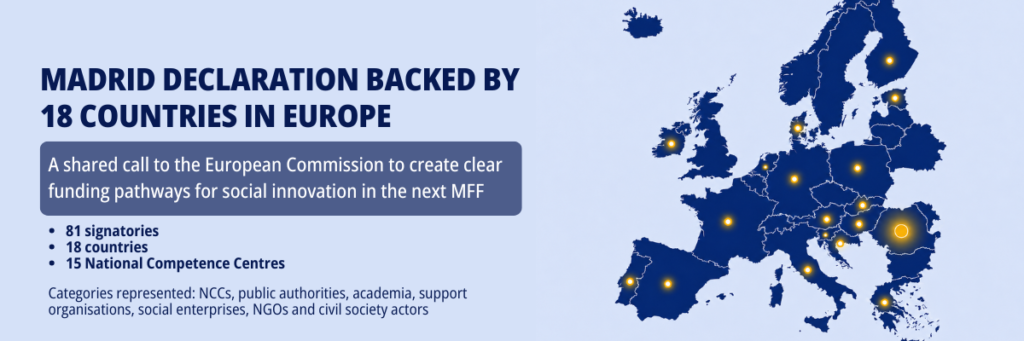
Backed by 81 organisations from 18 countries, including 15 National Competence Centres, the Declaration calls on the European Commission and MFF negotiators to create visible funding pathways for social innovation and to strengthen the ecosystem infrastructure needed to deliver it in practice.
Europe’s budget for the next seven years is currently being negotiated, but once the structure of the 2028–2034 Multiannual Financial Framework is set, it will be extremely difficult, almost impossible, to address any omissions later on. In this context, a growing European voice is emerging as 81 organisations from 18 countries have recently joined the Madrid Declaration for Stronger Recognition and Funding of Social Innovation in the EU Multiannual Financial Framework 2028–2034, calling for clearer funding pathways and stronger policy recognition for social innovation in the next EU budget cycle. The Declaration was presented on 5 May 2026 in Madrid during the National Competence Centres Mutual Learning Event and remains open to further support.
At this stage, the Declaration is backed by 81 organisations from 18 countries, including 15 National Competence Centres for Social Innovation and 66 other ecosystem actors from public authorities, academia, support organisations, social enterprises and civil society from: Austria, Croatia, Denmark, Estonia, Finland, France, Germany, Greece, Ireland, Italy, the Netherlands, Poland, Portugal and Romania. Signatories come from all five European consortia currently developing National Competence Centres all over the EU.
The document lands at a sensitive moment in the debate on the EU’s next Multiannual Financial Framework for 2028 to 2034. While the Commission’s proposal puts weight on competitiveness, resilience, skills, cohesion and social investment, the signatories argue that social innovation still appears only marginally in the proposed architecture, despite its relevance for labour market inclusion, territorial cohesion, democratic resilience and public service reform. Its signatories say this is a serious gap, given that social innovation already helps public authorities, civil society, social economy actors and support organisations respond to complex societal challenges that conventional instruments and standard delivery models do not adequately resolve.
Their message is fairly direct: if the next budget is meant to help Europe deal with overlapping social, demographic, digital and green pressures, it needs to make room not only for spending, but for ways of testing and scaling responses when standard systems are too rigid or too fragmented to cope.
The Madrid Declaration makes 5 clear requests to the Commission and MFF negotiators:
- stronger recognition of social innovation as a transversal delivery approach in the next MFF;
- clearer and more visible funding pathways for social innovation in the National and Regional Partnership Plans and the EU Facility;
- preservation and strengthening of dedicated support through the European Social Fund and related social investment instruments;
- better integration of social innovation into competitiveness, research and business support;
- and stronger support for ecosystem infrastructure, competence centres, intermediary organisations and impact measurement.
The initiative was coordinated by the Romanian National Competence Centre for Social Innovation, organised by fonduri-structurale.ro / consolid8, which presented the Declaration in Madrid as part of a wider European effort to strengthen the place of social innovation in the next MFF.
“Europe has a unique value proposition in the world: we build systems that support people’s lives and wellbeing. Living in this community offers something that no other region in the world currently provides. The Madrid Declaration is our commitment that social innovation must remain at the heart of the European project in the next financial period as well.”
– said Raluca Prelucă, Head of Romania’s National Competence Centre for Social Innovation.
Support for the declaration remains open, so the list of signatories is likely to grow. For now, the Madrid document marks a shift in how the field is presenting itself. What has often been discussed in terms of pilots, projects and experimentation is now being framed more openly as a budget and policy issue for the next EU cycle.
Link to the Madrid Declaration.
Current signatory National Competence Centres for Social Innovation:
Romanian Competence Center for Social Innovation (Romania); SED Consultants (Greece); Danish Social Innovation Academy (Denmark); ICCSI (Italy); L&R Social Research (Austria); HashNET (Croatia); National Foundation of Civil Society (Estonia); Innokylä / Finnish Institute for Health and Welfare, THL (Finland); Shipyard Foundation (Poland); Portugal Social Innovation (Portugal); AVISE (France); The Ministry of Labour, Social Affairs and Family of the Slovak Republic (Slovakia); Greek NCC for SI (Greece); Slovenian Competence Center for Social Innovation (Slovenia); National Competence Center for Social Innovation Germany (Germany).
All NCCs from the SEED2SCALE consortium have signed the declaration.
About the Madrid Declaration
The Madrid Declaration for Stronger Recognition and Funding of Social Innovation in the EU Multiannual Financial Framework 2028–2034 is a joint European call backed by National Competence Centres for Social Innovation and other ecosystem actors from 18 countries. It was presented in Madrid on 5 May 2026 during the National Competence Centres Mutual Learning Event and calls on the European Commission, Member States and MFF negotiators to create clearer support for social innovation in the next EU budget framework.